Balochistan Water Security and Productivity Improvement Project
Ensuring reliable water for a sustainable Quetta.
About the Project Director
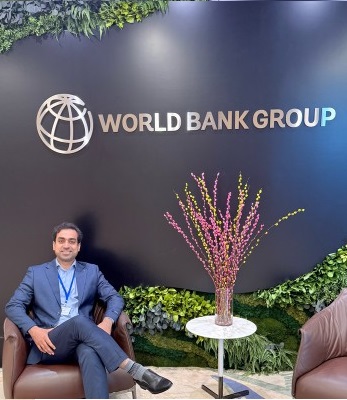
Tanveer Rahim is a water and sanitation professional with extensive experience in water supply and sanitation, infrastructure development, public-sector governance, utility management, policy reform, and climate-resilient WASH programming. He currently serves as Project Director, Balochistan Water Security and Productivity Improvement Project (BWSPIP) – Component-B, where he leads the implementation of initiatives aimed at strengthening urban water security, improving utility performance, and enhancing the sustainability and quality of water and sanitation services.
His professional experience encompasses the planning, design, implementation, and management of water supply systems, wastewater treatment facilities, pipeline networks, pumping and storage infrastructure, groundwater management initiatives, and institutional strengthening programmes. His work increasingly focuses on transforming water utilities through improved governance, financial sustainability, digitalization, asset management, operational efficiency, and evidence-based decision-making.
Introduction
In absence of any reliable and financially viable surface water source in and around Quetta the City is mainly dependent on groundwater resources. Overexploitation of groundwater due to rapid urbanization and ever- increasing water demand coupled with significant water losses through leakages in water supply network made it necessary to improve monitoring and management of the natural groundwater resources and the municipal water distribution system. It is also critical to develop a financially and environmentally sustainable and technically feasible plan to augment the water supplies through surface water resources in conjunction with the groundwater. These pathways to improve water security in Quetta can be undertaken in parallel. That is, while interventions are undertaken to improve quality of water services based on existing water availability and watershed management is pursued to increase groundwater recharge, the next generation of surface water conveyance infrastructure to increase water availability to Quetta can be prepared, appraised, and made investment-ready for financing.

Scope of the Project
The scope of the BWSPIP (Improvement of Quetta Water Supply) is multifaceted and encompasses a comprehensive set of interventions aimed at addressing water scarcity and improving water supply services in Quetta City.
01.
— Water & Wastewater Infrastructure Improvement Interventions
Improvement of urban water supply systems through upgraded storage, distribution, filtration, and the establishment of wastewater management cell.
02.
— Groundwater Improving and Monitoring Network
Strengthening groundwater sustainability and operational efficiency through real-time monitoring, controlled abstraction, recharge interventions, and development and rehabilitation of tube-well systems.
03.
— Water Supply Infrastructure Improvement
Enhancement of operational reliability and energy efficiency of water supply systems through pump upgradations and provision of backup transformer support.
04.
— Proposed Surface Water Conveyance Works required for Water Supply to Quetta City
Development of surface water conveyance infrastructure to enable safe integration of surface water sources and pilot zoning for controlled water supply management.
05.
— Works related to Rainwater Harvesting and Watershed Management
Implementation of GIS-based site selection, rainwater harvesting, watershed improvement works, and construction of groundwater recharge and monitoring structures..
06.
— Institutional Capacity Building of WASA
Strengthening WASA’s institutional, technical, and service delivery capacity through customer facilitation systems, staff training, and provision of critical operational and maintenance equipment.
Challenges
Water Supply Challenges in Quetta
As per the 2023 Census, the population of Quetta District is 2.58 million. Applying an annual growth rate of 2.27%, the projected population for 2026 is approximately 2.7 million; however, including an estimated 0.3 million settlers due to internal migration and Afghan refugee communities, the effective population is about 3 million, resulting in a domestic water demand of approximately 60 MGD at 20 GPCD.
Authorities
Working together to improve water security
and sustainable development in Balochistan.